

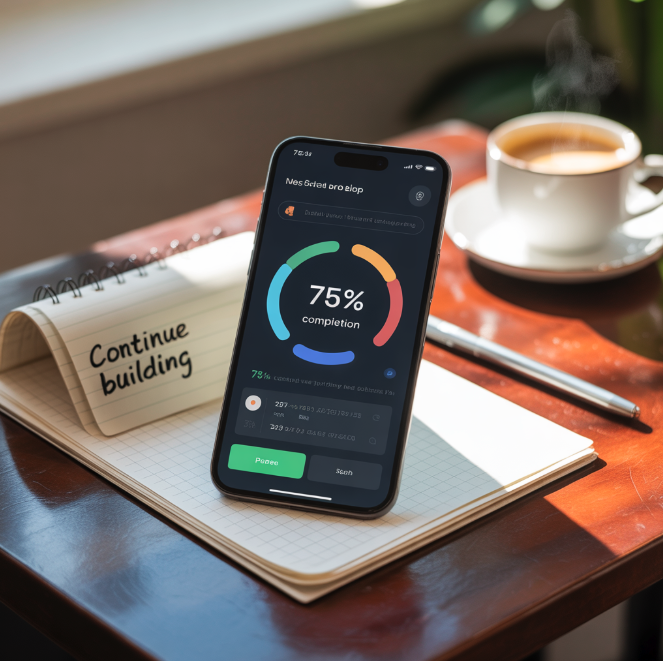
Every mobile app development journey is an adventure — full of ideas, plans, and big visions.
But not every project makes it to the finish line. A common scenario: the app remains unfinished — the team burned out, the budget stretched, or company priorities shifted.
At that point, many founders and managers face the same dilemma:
Is it better to complete the existing app or start over from zero?
At Grow-App, we’ve helped multiple clients in similar situations — and our experience is clear:
in most cases, it’s smarter and more efficient to build on the existing work and complete the project successfully.
Here’s why 👇
1. Saving Time and Budget
Starting from scratch means repeating every phase — analysis, design, development, testing.
That’s hundreds of hours and thousands of euros spent all over again.
An unfinished app, however, often already includes:
- a prototype,
- parts of the codebase,
- and ready-made designs.
Finishing the project can therefore mean:
- reusing existing modules,
- improving or refactoring the code,
- and building on what already works.
➡️ Result: you save both time and money that would otherwise be wasted on redoing work.
2. Making Use of Existing Investments
Every unfinished app already represents a significant investment — not only financially, but also in terms of know-how, experience, and testing.
Throwing it all away means losing that investment entirely.
Example:
A startup invested €30,000 into an app project that stopped at 70% completion.
Restarting it from scratch would have cost another €30,000,
but finishing the existing version only cost €15,000 — resulting in a fully functional app ready for the market.
➡️ Completing the app means maximizing the value of what you’ve already invested.
3. Faster Time-to-Market
In today’s market, speed matters.
The company that launches first often gains the competitive edge.
Starting over delays your launch — giving competitors time to move ahead.
An unfinished app gives you a head start:
- you can enter the market faster,
- start collecting user feedback earlier,
- and launch marketing campaigns sooner.
➡️ Even an “imperfect but functional” app on the market is better than a “perfect” one that never gets released.
4. Evolution Instead of Revolution
Partially completed projects often contain valuable ideas and solutions.
Finishing the app allows you to evolve — improving and expanding it step by step.
If you start from scratch, there’s a real risk of repeating past mistakes.
➡️ Completing the project lets you learn from experience and build on what already works.
5. The Psychological Effect — for the Team and Clients
An unfinished project feels like an open wound.
It causes frustration in the team and erodes client confidence.
Finishing the app, on the other hand, has a strong positive effect:
- the team regains motivation by seeing real results,
- the company can showcase a tangible product to clients and investors,
- overall trust in the project grows.
➡️ A completed app is proof that your company delivers on its promises.
6. When It Does Make Sense to Start from Scratch
Of course, not every project can or should be continued.
Sometimes, a fresh start is the better option — for example, when:
- the app is built on outdated or unsustainable technologies,
- the code is unmaintainable,
- or the business model or app goals have fundamentally changed.
➡️ In such cases, starting anew is wise — but even then, you can still reuse existing assets like design, data, and learnings.
How We Handle This at Grow-App
At Grow-App, we’ve worked on both types of projects — completions and full restarts.
For every client, we follow a structured process:
- Audit the unfinished project – we review the code, design, and workflow.
- Define what can be reused – and what needs to be rebuilt.
- Propose the optimal path – completion or restart.
- Deliver a finished, market-ready app – quickly, safely, and efficiently.
Summary
An unfinished app is not a failure — it’s an opportunity.
Completing it means saving time, reusing investments, entering the market faster, and rebuilding trust with both users and investors.
➡️ Starting from scratch only makes sense if outdated technologies or major strategic changes prevent continuation.


