

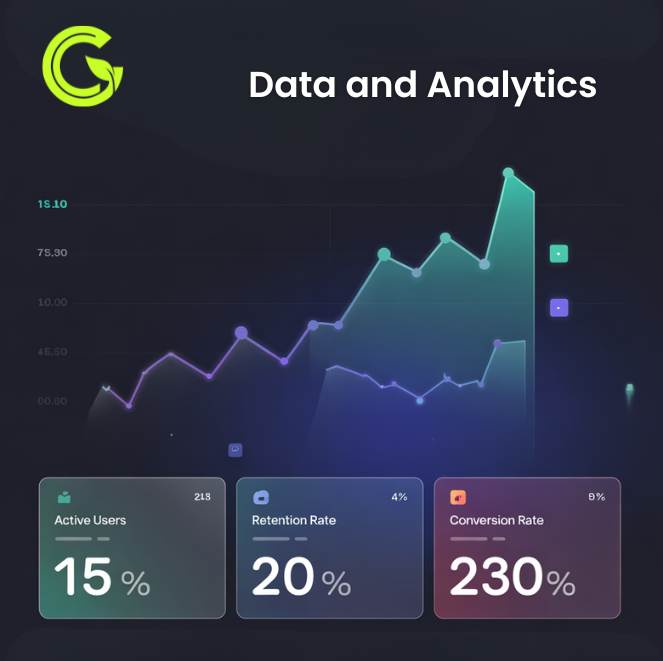
How to Know If Your App Delivers Results: The Basics of App Analytics
Launching a mobile app is a big step — but knowing whether it actually delivers results is even more important.
Many companies focus on development and launch but forget to ask the key question: How do we know if the app really works?
The answer lies in app analytics — the systematic tracking and evaluation of data that shows whether your app meets its goals and where there’s room for improvement.
At Grow-App, we believe that strong analytics are the foundation of success.
Without them, you’re guessing — with them, you have facts and numbers that guide your decisions.
Why App Analytics Matter
A mobile app isn’t just a business card — it’s a tool that should bring value:
- Increase sales
- Simplify customer service
- Improve communication
- Strengthen user loyalty
Without analytics, you can’t tell whether these goals are being achieved.
It’s like running a company without accounting — things are happening, but you don’t know their actual impact.
➡️ Analytics answers one simple question: Is it working?
1. Set Clear Goals
The first step is defining what you expect from your app.
Goals will differ depending on your business type:
- E-commerce: number of orders, average order value, repeat purchases.
- Startup: number of registrations, active users, retention rate.
- Internal company app: process efficiency, number of tasks completed through the app.
➡️ Without clear goals, you can measure anything — but learn nothing.
2. Key Metrics You Should Track
📲 Number of Downloads
Shows interest in the app, but it’s not the only measure of success.
👤 Active Users (DAU/MAU)
How many people actually use your app daily (Daily Active Users) or monthly (Monthly Active Users).
⏱️ Retention Rate
How many users return to your app after 1, 7, and 30 days.
Retention is crucial — an app without returning users quickly fails.
⭐ Ratings and Reviews
Numbers tell one story, but user comments reveal the full picture.
💶 Conversions
The rate at which users perform desired actions — purchases, registrations, or form submissions.
🔄 Churn Rate
The percentage of users who stop using your app.
➡️ These metrics show not just popularity, but your app’s long-term value.
3. Tools for Tracking Analytics
There are many tools on the market to help you collect and analyze data:
- Google Analytics for Firebase – a comprehensive tool for tracking user behavior.
- Mixpanel – advanced analytics with a focus on user segmentation.
- Appsflyer – campaign measurement and user attribution.
- Amplitude – data visualization and journey mapping.
➡️ The right tool depends on what you want to measure and how deeply you want to analyze it.
4. How to Interpret the Results
Data alone are just numbers — what matters is interpretation.
Example 1:
You have 10,000 downloads, but a 30-day retention rate of only 5%.
That means the app fails to engage users — it’s time to review UX or functionality.
Example 2:
You have few downloads but high conversion and retention rates.
That means your product has strong potential — it just needs marketing support.
➡️ The key is to look beyond one metric and focus on the whole picture.
5. How to Build a Strong Analytics Strategy
- Define your goals – what the app should achieve.
- Choose your metrics – the numbers that reflect those goals.
- Select the right tools – based on data depth and type.
- Evaluate regularly – monthly reports, quarterly reviews.
- Make data-driven decisions – test, measure, and optimize.
6. Why You Shouldn’t Underestimate Analytics
Companies that ignore analytics rely on assumptions — and assumptions lead to bad decisions:
- adding features no one uses,
- investing in ineffective marketing,
- letting the app stagnate until competitors overtake them.
➡️ On the other hand, companies that use analytics know exactly what works — and where to focus next.
Summary
Analytics are the heartbeat of every successful mobile app.
Without them, you’re guessing — with them, you know.
👉 Remember:
- Define your goals first.
- Track the right metrics.
- Interpret data in context.
- And most importantly — make decisions based on facts, not feelings.


