
How to Sell Workout Videos Online: 3 Routes from YouTube to Your Own App
Author
Grow-App
There are three ways to sell workout videos: share them for free on social media and earn indirectly, sell them through a ready-made platform that charges a monthly fee or a percentage, or sell them through your own platform or app under your own name. Most coaches are best served by the second route at the start. Your own solution starts to pay off once you have hundreds of paying clients, or when you need videos, programmes and bookings in one place.
This article is for coaches who know the situation: clients ask whether they can train at home, you send videos over WhatsApp and nobody pays for them. We go through all three routes and their fees, and at the end we calculate what you keep from 100 and from 500 subscribers.
First: what exactly are you selling?
Before you think about where to sell your videos, be clear about what you are selling. The same set of videos can be packaged in four ways, and each fits a different route:
- A workout library on a monthly subscription. Clients pay monthly and play whatever they want. It works when you add new content regularly.
- A programme with an end. For example "6 weeks to a stronger core", with a new workout unlocking every day. It sells as a one-off purchase and is easy to promote.
- A course. Structured lessons with explanations, for beginners or for other instructors.
- An add-on to in-person sessions. Only your clients get the videos, as part of a membership or a class pass.
Most successful coaches start with one model and add others over time. Usually a subscription library, because it brings recurring income.
Route 1: YouTube, Instagram and social media
You publish videos for free and earn indirectly: from ads, brand partnerships, or clients that social media brings to your in-person sessions.
What it costs: nothing but time. What you get: reach and trust from people who don't know you yet.
Earning directly on YouTube has an entry gate, though. Channel memberships and fan funding open at 500 subscribers and 3,000 watch hours in the past year (or 3 million Shorts views). A share of ad revenue only comes at 1,000 subscribers and 4,000 watch hours.
When it makes sense: as a shop window. You show how you train and send people to your paid content. As the only source of income it rarely works for an independent coach. And you are only renting that audience: someone else sets the rules and the algorithm.
Route 2: A ready-made platform
There are services built exactly for selling videos and memberships. You sign up, upload videos, set a price, and the platform handles payments and client access. They differ mostly in how they take their money:
- A percentage of revenue. Patreon, for example, takes 10% of membership income from new creators, plus payment processing fees.
- A monthly fee plus a fee per subscriber. Uscreen's Growth plan, for example, costs $149 a month on annual billing, plus $1.99 for every active subscriber.
- A fixed monthly fee. Kajabi, for example, starts at $179 a month, with limits on the number of products and contacts.
- Apps built for coaches. Many let you create workouts and invite clients, usually with a free trial.
Pros: you can start within days, there is nothing to develop and the risk is small. If it doesn't work out, you cancel.
Cons: you work under someone else's brand or in someone else's environment. Fees grow with your client count, and you are limited to what the platform can do. The most common pain: videos in one place, bookings in another and payments in a third.
When it makes sense: at the beginning. While you are testing whether your clients will really pay for videos, a ready-made platform is the cheapest way to find out.
Route 3: Your own platform or app
Your own solution carries your name, logo and colours. Clients open it as a website or download it from the App Store and Google Play. It can combine everything you now do in three places: the video library, programmes, subscriptions, session bookings and new-workout notifications.
Pros: your own brand, no per-client fees, and client contacts and data belong to you. The solution does exactly what you need, not what the average platform user needs.
Cons: you need an upfront investment and someone to look after it. And you need something to sell. An app of your own won't attract clients by itself.
When it makes sense: once you know clients pay and platform fees start to hurt. Or when you need something ready-made platforms can't do.
You don't need to know whether you need a website or a mobile app. The usual start is a web platform that works on phones and computers, with a store app added once your client base grows. We explain the differences in our web vs. app comparison.
Comparison: what you keep from 100 and 500 subscribers
A worked example: a subscription at €15 a month. With 100 subscribers that is €1,500 a month, with 500 subscribers €7,500. The table only shows fees that grow with revenue or client count. Platform prices are taken from their price lists as of September 2026, in US dollars as they publish them.
| Route | Fees at 100 subscribers | Fees at 500 subscribers |
|---|---|---|
| Percentage of revenue (Patreon, 10% + payments approx. 3%) | approx. €195 | approx. €975 |
| Fee per subscriber (Uscreen Growth, annual billing) | $348 + payments | $1,144 + payments |
| Fixed fee (Kajabi Basic) | $179 + payments | $179 + payments |
| Own solution, web payment (1.5% + €0.25) | approx. €48 | approx. €238 |
| Own app, in-app payment (15% store fee) | €225 | €1,125 |
Three things follow from the table:
- Percentages and per-subscriber fees grow with your success. At 500 clients you pay the platform, over a year, as much as or more than it costs to build and run your own solution for a year.
- A fixed monthly fee works out well as you grow. At the price of plan limits and your clients living inside the platform's environment.
- With your own solution, where the client pays matters. A web payment is far cheaper than an in-app payment, where the store takes 15%. App Store and Google Play rules in the EU are changing in 2026, so it is worth calculating during the design.
Your own solution also has an upfront investment and monthly maintenance. They are not in the table because they don't grow with your client count. You can find current prices on the app for fitness coaches page. With a few dozen clients, your own solution doesn't pay off financially. With hundreds, it starts to make sense.
When should you switch to your own solution? A quick test
Your own platform or app makes sense if you can answer yes to at least three of these:
- Clients already pay you for videos (or would, if it were easy).
- You have at least a hundred paying clients, or a realistic path to them.
- Platform fees are approaching an amount that hurts.
- Your videos, programmes and bookings live in different places and clients get lost.
- You want your own brand, not someone else's logo.
- You want your client contacts and to know who trains and who is drifting away.
If you answered yes to only one or two, stay with a ready-made platform for now. Come back to it when your client base grows.
How to start this month
Whichever route you choose, the first steps are the same:
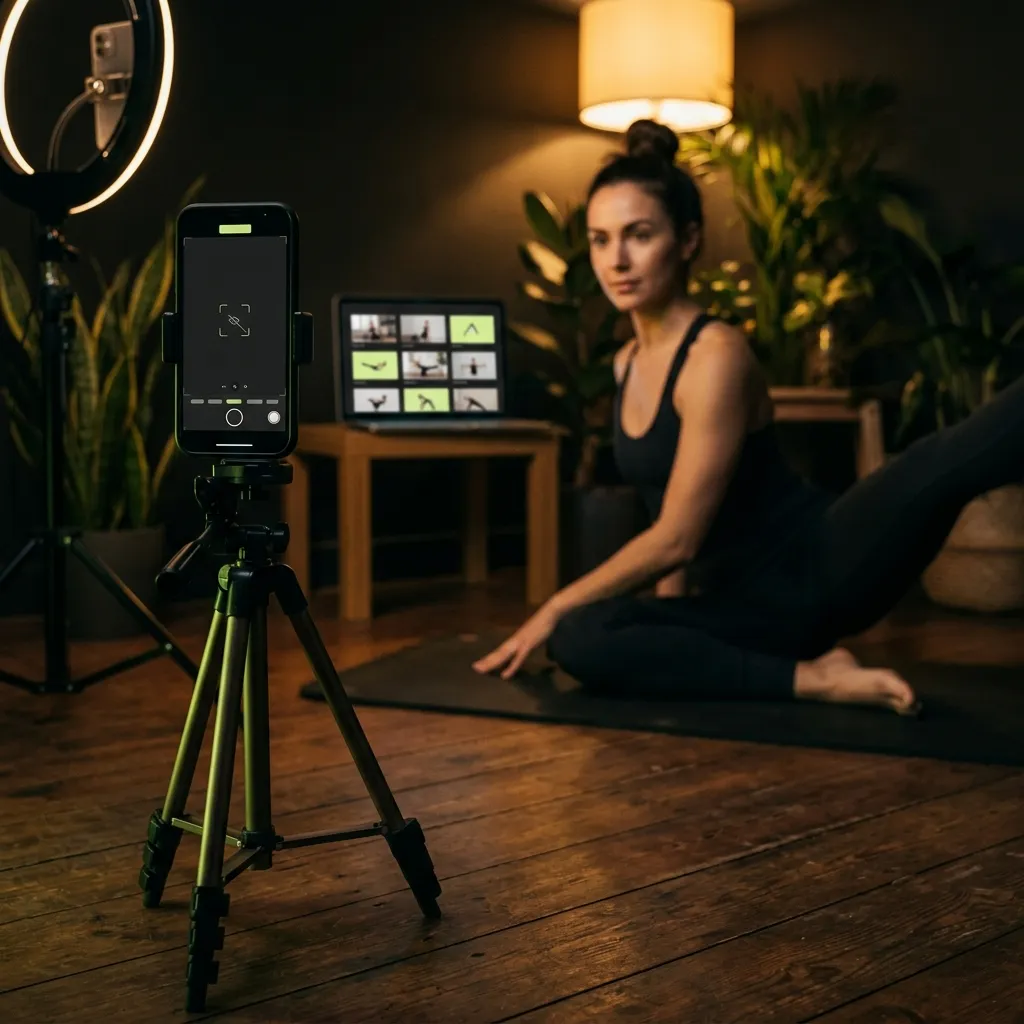
- Record 8 to 10 workouts. A phone on a tripod, window light and a clip-on microphone are enough. Clients pay for your coaching, not for film production.
- Name them the way clients search. "20 minutes, beginner, back" works better than "Workout #7".
- Offer them to your own clients first. Ten paying people from your studio tell you more than a thousand followers.
- Set a price and ask. How much would they pay a month? What would they like to see? What's missing?
- Only then pick a tool. Once you know what clients want and what they pay, choosing a route is easy.
Frequently asked questions
Do I need a lot of followers to sell videos?
No. The first paying clients almost always come from people who already train with you in person. Social media helps you reach new people, but it isn't a requirement.
Can I start with a ready-made platform and move to my own later?
Yes, and it is a sensible path. When choosing a platform, check that you can export your client contacts. With them, you can move without losing anyone.
Do I need a website or a mobile app?
You don't need to know at the start. It depends on how your clients will train (at home in front of the TV, on their phone at the gym), how many you have and what your budget is. We work that out together during the design.
Have videos, clients and the ambition to turn it into your own brand? See what your own app for fitness coaches can do, or write us a few sentences about your idea. No technical brief needed.
Want a solution of your own?
Your workouts, programmes and bookings under your own name. Clients train without you and pay monthly.
You don't need to know whether you need a website or an app. Just tell us what you want to build.