
How to Price a Subscription: Everything to Include (the Expiro Example)
Author
Grow-App
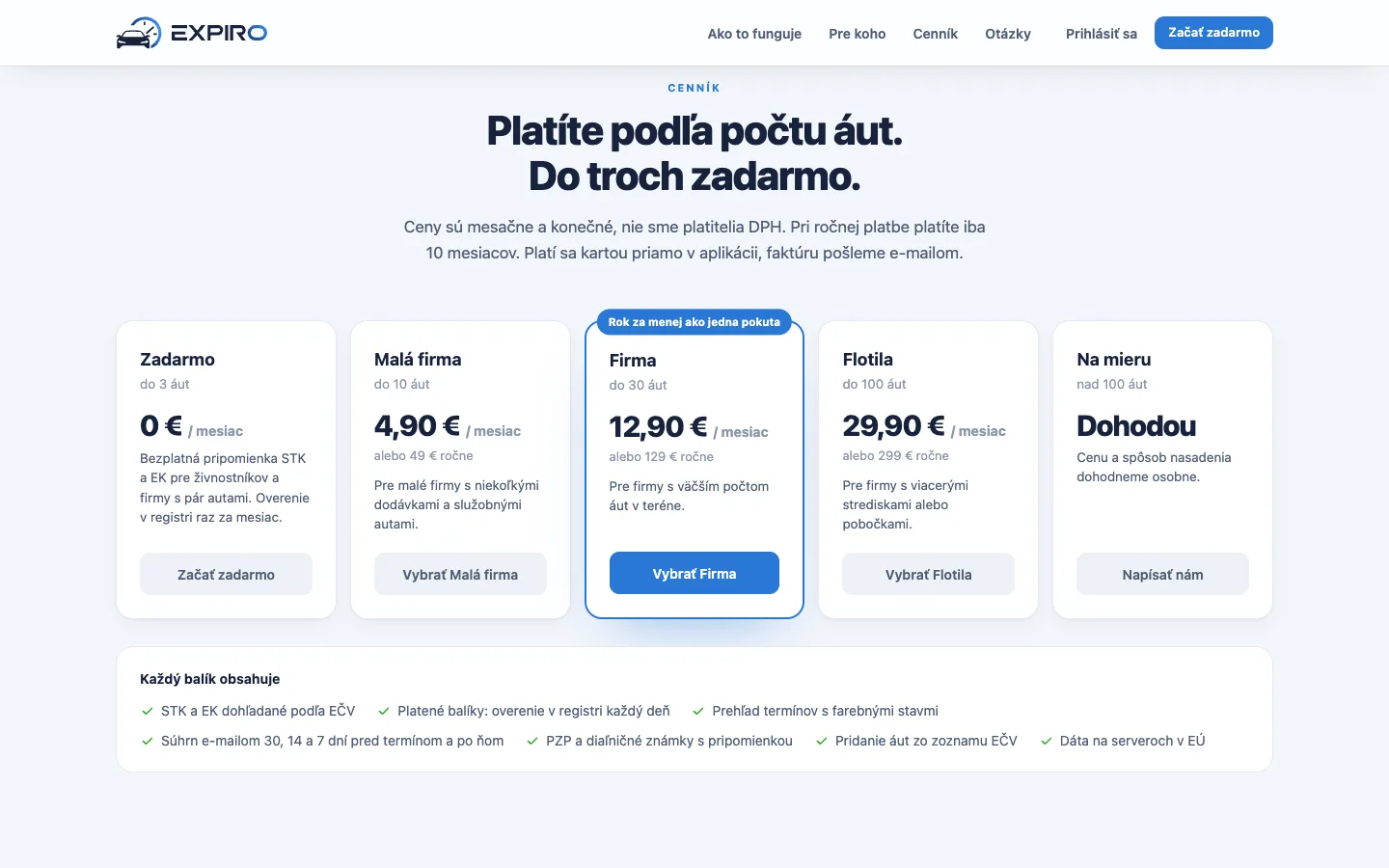
To price a subscription, first work out what one customer costs you per month, then add the payment fee, VAT and a share of your fixed costs, and compare the result with what the problem costs the customer. Plan for the worst case, not the average, and don't forget free users, who cost something too. For our Expiro service, that meant plans from €4.90 a month that cover their costs even if the data supplier decides to tighten its terms.
This article is for anyone preparing a service or app with a monthly subscription who doesn't know where to start. We go through the items most often forgotten in a price list and show each one with real numbers. Expiro is a web service that tracks technical inspection and emission inspection deadlines for company cars. We calculated its pricing down to the cent.
What goes into a subscription price?
Most people start with the question "what does the competition charge?". That is a good check at the end, but a bad starting point. The competition may have different costs, an investor or a mistake in their spreadsheet. Start with what you pay:
- Cost per customer. Everything you pay for each customer separately: paid data, text messages, AI calls, file storage, emails.
- Payment fees. The payment provider takes a percentage and a fixed amount from every payment.
- App store commission, if you sell directly in the app. For a small business, usually 15%.
- VAT. If you are VAT-registered, part of the price goes to the state.
- Fixed costs. Hosting, domain, accounting, email, suppliers' minimum plans.
- Free users. They pay nothing, but you still have costs for them.
- Support and refunds. Time spent answering customers and money returned on withdrawal.
- Development and maintenance. The service also has to pay for the work that built it and keeps it running.
The first four items grow with every customer. They decide whether you make money on a customer at all. The rest decides how many customers you need for the service to pay for itself.
What does one customer cost?
At Expiro, the main cost is data from the vehicle register. Expiro buys it from a supplier that sells bundles of lookups:
| Supplier plan | Monthly price | Lookups | Price per lookup |
|---|---|---|---|
| Basic | €29 | 5,000 | 0.58 cents |
| Higher | €89 | 25,000 | 0.36 cents |
Adding a car costs 3 lookups. A regular check of one car costs 1 to 2 lookups, depending on what we are allowed to store. Paid Expiro plans check every car every day, so up to 60 lookups a month per car.
Here is the first lesson: plan for the worst case. In normal operation, a daily check costs 1 lookup. But we set prices based on 2, because it depends on a permission from the supplier that may end. If we had planned on the average, one change in the supplier's terms would put us at a loss on every customer.
Payment fees hurt more on small amounts
For a standard European card, the payment provider takes about 1.5% + €0.25 per payment. The fixed part is very noticeable on small amounts:
| Expiro plan | Price | Fee | Share of price |
|---|---|---|---|
| Small business, monthly | €4.90 | €0.32 | 6.6% |
| Business, monthly | €12.90 | €0.44 | 3.4% |
| Fleet, monthly | €29.90 | €0.70 | 2.3% |
| Small business, yearly | €49 | €0.98 | 2.0% |
| Business, yearly | €129 | €2.18 | 1.7% |
On the cheapest monthly plan, the fee eats almost 7% of revenue; on the yearly plan, only 2%. That is one more reason to offer a discounted yearly subscription. At Expiro, a year costs the same as 10 months.
If you sold directly in the app through Apple or Google, instead of the payment provider fee you would usually count on 15% of every payment. That is why Expiro sells subscriptions only on the web, and the upcoming mobile app will be a free companion. The details are in the article Subscriptions in your own app.
Does every plan pay for itself?
This is how the Expiro numbers look with a full number of cars in the plan, a daily check and the worst case of data usage:
| Plan | Revenue after payment fee | Data on the basic plan | Data on the higher plan |
|---|---|---|---|
| Small business, 10 cars | €4.58 | €3.48 | €2.14 |
| Business, 30 cars | €12.46 | €10.44 | €6.41 |
| Fleet, 100 cars | €29.20 | doesn't fit | €21.36 |
The first draft of the price list was €4.90 / €9.90 / €19.90. It looked reasonable and felt friendly to customers. When we recalculated it for the worst case, both Business and Fleet lost money on every customer. So we raised the prices of the larger plans to €12.90 and €29.90.
The customer still pays less than 50 cents a month per car, and 30 cents on Fleet. The margin in the worst case is thin on purpose. In normal operation, data costs are half as much, and the difference is the buffer.
What does the problem you solve cost?
Costs set the lower limit of the price. The upper limit is set by the customer: what the problem you solve costs them.
With Expiro, it is simple. A missed technical inspection and emission inspection mean a fine of €165 for each inspection, €330 in total. The Business plan for up to 30 cars costs €129 a year. That is why the pricing page says "A year for less than one fine". The customer doesn't have to calculate anything; the comparison does it for them.
Find a similar anchor for your service. An hour of work you save. A customer who doesn't leave. A fine that never arrives. A price that is a fraction of that amount sells easily. A price you have to justify with features does not.
The free plan: the best advertising and the biggest risk
A free plan lets customers try the service without risk. At the same time, every free account costs you something, and only a small share of users pay. We planned on 5 to 10%. At Expiro, we handled this with three rules:
- Enough to try, too little for permanent use. 3 cars are free. A business can try the whole overview and hits the limit at the fourth car.
- Cheaper to run. Free cars are checked once a month, paid ones every day.
- Paying customers come first. Lookups for paying customers are reserved in advance. Free cars only get what is left over. So even a thousand free accounts won't push the service into a more expensive supplier plan.
Ask yourself: what happens if a thousand people sign up tomorrow and nobody pays? If the answer is "we pay for it out of our own pocket", your free plan is too generous.
Step costs and cash flow
Suppliers don't sell one lookup at a time, but in plans. So costs don't grow smoothly; they jump. This is Expiro's monthly result after payment and data fees, by number of users, not yet counting hosting and accounting:
| Users | If 10% pay | If 5% pay |
|---|---|---|
| 100 | −€3 | +€2 |
| 200 | +€83 | −€27 |
| 300 | +€9 | +€3 |
| 500 | +€182 | +€65 |
| 1,000 | +€612 | +€59 |
The numbers don't jump by accident. When moving to a more expensive supplier plan, the service is briefly around zero or slightly negative. And from the first paying customer, you have to pay at least the supplier's basic plan, €29 a month. One Fleet, three Business plans or seven Small business plans cover it.
The worst scenario at the start? A single customer with a Fleet full of 100 cars. It doesn't fit on the basic plan, and until more customers arrive, that is about €60 a month in the red. Yearly payment upfront covers gaps like this. That is why we offer it with a two-month discount.
VAT, consumers and refunds
VAT. Expiro prices are final, because the operator is not VAT-registered. Once you become registered, VAT is added to the price. Businesses can deduct it; with private customers, you either add it to the price or pay it out of your margin. Decide this in advance, not on the day you register.
Consumers. If you also sell to individuals, not just businesses, a consumer may withdraw from a subscription within 14 days. At Expiro, we refund the full amount in that case. Keep this in your buffer, even if it rarely happens.
Cancellation. On a regular cancellation, the paid period is not refunded; the subscription simply runs to the end. State this clearly in your terms and conditions and next to the payment button.
What we rejected for the price list
| Option | Why not |
|---|---|
| €19 for up to 30 cars, €49 for up to 100 cars | Too big a jump from €0 for a business with 4 to 10 cars. |
| €4.90 / €9.90 / €19.90 | In the worst case for costs, both Business and Fleet lost money. |
| 1 car for free | You can't try the overview of a whole fleet with it. |
| The customer copies the vehicle identification number (VIN) from the registration certificate to make the lookup cheaper | It saves us cents and costs the customer their nerves. |
| A cheaper data source | One prohibited commercial use, the other updated data once a quarter. |
When to revisit the price list?
The first price list is an estimate. So alongside it, we also wrote down when we will open it again:
- After the first 20 to 50 paying businesses. Real conversion and the real number of cars in plans will replace the estimates.
- When the supplier changes prices or terms. That is when the buffer we left in the prices matters.
- When moving to a more expensive supplier plan starts to mean a loss over the long term.
Prices can be raised later for new customers. The first ones can keep their original price. It is a cheap reward for their trust and a good opening for a conversation about why they stayed.
A plan for one evening
- List everything you pay per customer per month, and take the worst reasonable case.
- Add the payment fee for both monthly and yearly payments, plus any app store commission.
- Calculate each plan at full usage. Each one must cover its costs.
- Calculate the free plan for a thousand users who never pay.
- Go through your suppliers' price jumps and find where you will briefly be in the red.
- Find your value anchor: what the problem you solve costs the customer.
- Write down when you will open the price list again.
Frequently asked questions
Should I start with a low price and raise it later?
Start with a price that covers your costs even in the worst case. A price that is too low is hard to raise, and the customers it attracted are the first to leave. You can raise the price for new customers, and the first ones can keep the original.
What percentage of users will pay?
For services with a free plan, 2 to 10% is the usual assumption. We planned for both 5% and 10%, and the price list had to survive both cases. Only real operation will tell you the actual number.
Monthly or yearly subscription?
Both. Monthly lowers the barrier to a first purchase; yearly gives you money upfront, a lower share of fees and a customer who doesn't cancel every month. A two-month discount is common and easy to understand.
Is it worth selling the subscription directly in the app?
For the customer it is the most convenient, for you the most expensive. If the service lives mainly on the web, like Expiro, sell on the web and keep the app as a companion. If the app is the main product, include the store commission in the price.
Preparing a subscription service and want the numbers worked out before you start programming? See how Expiro came about, or write us a few sentences about your idea. We will go through the price list and costs with you before development.
Stay one step ahead
At Grow-App, we turn new technology into practical products. We can help you create an app that works today and remains ready for tomorrow.
Talk to us and we will turn your idea into a modern app built for the future.